

Queen Viharamahadevi is arguably the most revered female figure in Sri Lankan history. Her life, transitioning from a sacrificial princess to the matriarch of the Sinhalese restoration, is a saga of extreme self-sacrifice, religious devotion, and strategic political influence.
Royal Lineage
Born as Princess Devī, she was the daughter of King Kelani Tissa, the ruler of the western principality of Kelaniya. She belonged to a royal lineage descending from Yatthalaya Tissa, making her a relative of the ruling house of Ruhuna.
Father’s Sacrilege
King Kelani Tissa’s queen entered into a secret relationship with his younger brother, Prince Ayya Uttika. When the king discovered the affair, he planned to publicly disgrace the prince, forcing Uttika to flee to Udugampola.
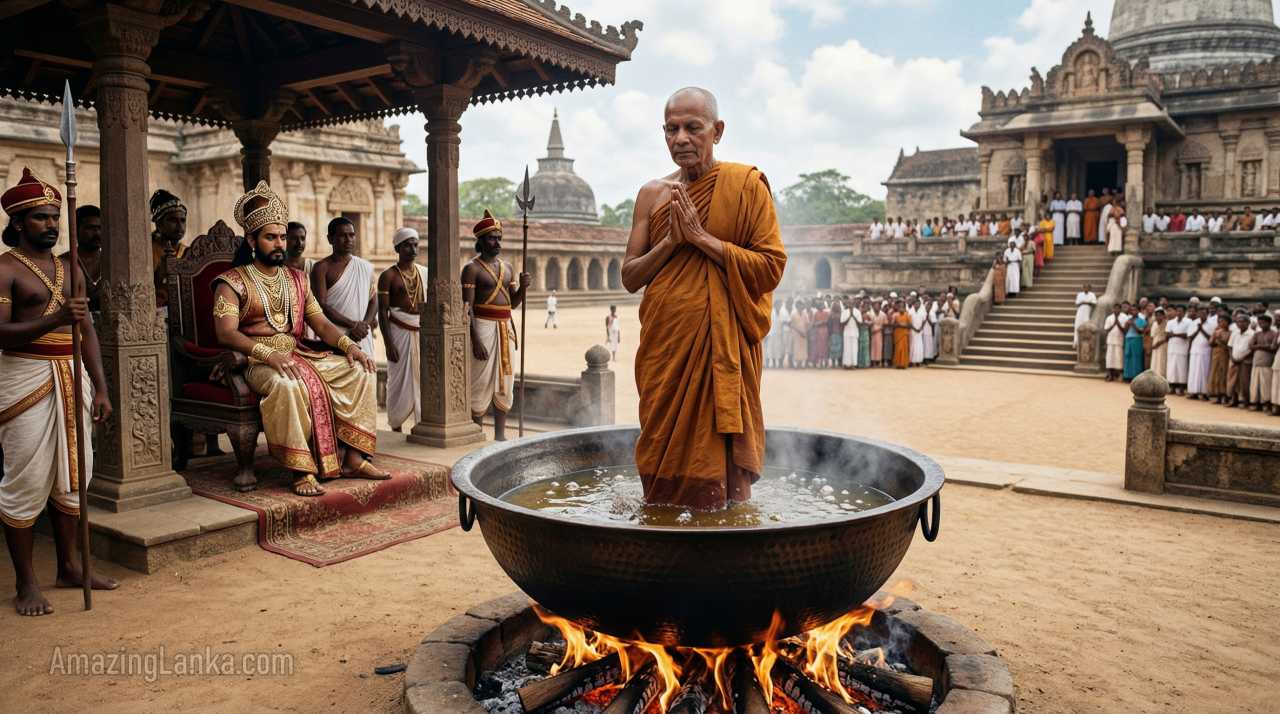
In an attempt to maintain contact, Uttika sent a message through a messenger disguised as a monk, who joined a group of 500 monks visiting the palace for alms. After the meal, the messenger dropped a letter intended for the queen. The king found it and, unable to recognize the handwriting, wrongly assumed it belonged to the chief thera, who had once been Uttika’s teacher.
Believing he had been betrayed, the king, in a fit of anger, ordered the innocent monk to be executed by placing him in a pot of boiling oil.

The Great Sacrifice: The Journey Across the Sea
Soon after this event, a devastating tsunami struck the western coast—possibly the earliest recorded tsunami in human history. The sea surged inland, inundating cities and causing widespread destruction. This calamity was believed to be divine retribution for the king’s sacrilegious act. In order to appease the gods and protect his people, Kelani Tissa was advised to offer his most precious possession—his daughter—to the sea.
Princess Devī accepted her fate with remarkable courage and a sense of duty to her people. She was placed in an ornately decorated golden vessel bearing an inscription intended for any who might find her: “Devī, daughter of King Kelani Tissa, offered to the sea.” The vessel was launched from Kelaniya and carried southward by winds and ocean currents.
Rescue and Marriage in Ruhuna
The vessel eventually drifted toward the shores of Ruhuna, approaching the coast near Māgama. Local fishermen discovered it and informed King Kākavaṇṇatissa (Kavan Tissa). Upon reading the inscription and recognizing her royal lineage, the king rescued her.
She came ashore near a monastery known as Laṅkā Vihāra, which led to her being given the name Vihāramahādevī. This landing site is generally identified with Muhudu Mahā Vihāraya in Kirinda, although some traditions associate it with the present Muhudu Mahā Vihāraya in Potuvil.
Kākavaṇṇatissa subsequently married her, elevating her to the position of Chief Queen of the Ruhuna Kingdom. This union represented a significant political alliance, effectively linking the two most powerful Sinhalese royal houses of the southern and western regions. The site traditionally associated with their wedding is Magul Mahā Vihāraya in Lahugala.
Children and the Queen’s Prophetic Cravings
Vihāramahādevī bore three children who would play decisive roles in the future of the island. Her eldest son, Gāmaṇī Abhaya, later became known as Duṭṭhagāmaṇī (Duṭugemuṇu), the celebrated monarch who unified Sri Lanka. Her second son was Tissa (Saddhā Tissa).
During her first pregnancy, the chronicles record three extraordinary “longings” (dola-duka) that were interpreted as omens of her son’s destiny:
- To rest upon a couch with a honeycomb as a pillow and to consume the remaining honey after sharing it with twelve thousand monks
- To drink water used to wash a sword that had beheaded the chief warrior of Elāra, while standing upon that warrior’s head
- To wear garlands of fresh lotus flowers gathered from the marshes of Anurādhapura, then under Tamil control.
In response to a royal proclamation, two brothers discovered an overturned vessel filled with honeycomb in a coastal thicket. The site of this discovery became known as Migamuva (modern Negombo).
Fulfilling her remaining desires required a daring incursion into the Tamil-held capital of Anurādhapura. The warrior Veḷusumana, serving under King Kākavaṇṇatissa, undertook this mission in disguise. After gaining the trust of Elāra’s horsekeeper, he gathered lotus flowers from the marshes, seized the king’s state horse (Väha), and revealed his identity. When pursued by Elāra’s chief warrior, Nanda Sārathi, he defeated and decapitated him. Returning to Ruhuna with the severed head, the sword, and the lotus flowers, he enabled the queen to fulfill her ritual, including standing upon the fallen warrior’s head.
Epigraphical Evidence and Historicity
Archaeological discoveries provide independent confirmation of Vihāramahādevī’s historical existence beyond the literary chronicles. A group of fourteen inscriptions discovered at Koṭādämūhela in the Yala region refer to a princess named Abi Savera. She is identified as the daughter of Mahatisa—widely believed to be Kelani Tissa—and the wife of Aya Tisa (Prince Tissa, a name commonly associated with the lineage of Gothābhaya and Kākavaṇṇatissa).
Scholars, including S. Paranavitana, have proposed that “Savera” represents the queen’s original name. Over time, this name evolved linguistically from Savera to Havera, then to Vahera—an early Sinhalese form of Vihāra. This progression helps explain the Pali rendering of her name as Vihāramahādevī in the chronicles.
References
- Codrington, H. W., & Hocart, A. M. (1926). A Short History of Ceylon. MacMillan and Co. Limited.
- Gunasekara, B. (1900). The Rajavaliya or a historical narrative of Sinhalese kings from Vijaya to Vimala Dharma Suriya II. George J. A. Skeen.
- Maddage, R. (2023). Five Sri Lankan royal families. Roshan Maddage Don.
- Mahanama, Geiger, W., & Bode, M. H. (1912). The Mahavamsa or the Great Chronicle of Ceylon. Translated into English by Wilhelm Geiger. For the Pali Text Society by Henry Frowde.
- Nicholas, C. W. (1963). Historical Topography of Ancient and Medieval Ceylon. Journal of the Ceylon Branch of the Royal Asiatic Society, New Series Volume VI(Special Number).
- Paranavitana, S. (1959). History of Ceylon (University of Ceylon): Vol. 1 (part 1)–3. Ceylon University Press.
Also See
0-09 m (90) 10-19 m (77) 20-29 m (47) 30-39 m (50) 40-49 m (25) 50-99 m (50) Ambalama (184) Ancient Anicuts (35) Articles (0) Asanaghara (8) Ashtapala Bodhi (5) Attraction Articles (3) Attractions (267) Beaches (10) Biosphere Reserves (3) Botanical Gardens (5) Bridges (35) Cave Art (13) Caving (7) Churches (30) Cities (9) Destinations (18) Dethis Pala Bodhi (27) Devalaya (51) Events (3) Flora and Fauna (83) Forts (52) Heritage (1986) Heritage Articles (27) Historic Events (7) History (7) Hot Springs (9) Hydro Heritage (105) Irrigation Articles (4) Islands (15) Kings of Sri Lanka (188) Kovils (30) Kuludage (11) Lighthouses (29) Memorials (57) Mile Posts (6) Misc (1) Mosques (4) Museums (15) National Parks (24) over 100 m (20) Pabbatha Vihara (13) Padhanagara (27) Personalities (211) Pillar/Slab Inscriptions (48) Popular Tourist Attractions (231) Pre Historic Burial Sites (24) Prehistory (46) Prehistory Articles (2) RAMSAR sites (6) Ravana (16) Reservoirs (73) Rock Inscriptions (36) Ruins in Wilpattu (11) Ruins in Yala (25) Santuaries (7) Sluice Gates (17) Stone Bridges (18) Strict Nature Reserves (3) Sumaithangi (3) Survey Towers (18) Tampita Vihara (243) Travel (5) View Points (24) Walawwa (13) War Memorials (26) Waterfalls (381) Wildlife Articles (28) Yathuru Pokuna (4)
Abhayagiri Monastery (20) Ampara District (196) Anuradhapura District (242) Badulla District (123) Batticaloa District (148) Colombo District (123) Galle District (76) Gampaha District (63) Hambantota District (124) Jaffna District (77) Kalutara District (53) Kandy District (218) Kegalle District (169) Kilinochchi District (13) Kingdom of Anuradhapura (89) Kingdom of Kandy (19) Kingdom of Kotte (9) Kingdom of Polonnaruwa (58) Kurunegala District (186) Maha Vihara (18) Mannar District (47) Mannar Island (10) Matale District (94) Matara District (53) Mihintale (22) Monaragala District (113) Mullaitivu District (39) Negombo (5) Nuwara Eliya District (126) Polonnaruwa District (138) Puttalam District (44) Ratnapura District (178) Trincomalee District (80) Vavuniya District (34) waterfalls in Sinharaja (3) z Delft 1 (5) z Jaffna 1 (20) z Jaffna 2 (26) z Jaffna 3 (14)